Friday, April 4, 2014

Investigations #3


Today in my Animal Physiology class, I saw a picture of a person who had severe swelling of the feet. I was shocked and intrigued at the same time, so I decided to do a little investigation about a disease called elephantiasis. The disease also known as lymphatic filariasis affects over 90 million people in the world, particularly in the tropical and subtropical parts of the world. The disease is characterized by edema with thickening tissues, especially in the legs, arms, and the genitals.

The disease is transmitted by Filarial worms that are ingested by arthropod vectors like mosquitoes, which would then be transmitted to humans when they bite humans for blood. The infection causes a great inflammatory immune response, which results in the development of symptomatic lymphatic obstruction. The larvae of the Filarial worms migrate towards the lymphatic vessels where they would develop to adult worms. The full mechanism of this disease is still not completely understood. However, it is known that there is an increase in the levels of IgE and IgG4. In addition, people who are infected with this disease have been found to have an impaired lymphocyte proliferation response to the Filarial worms and have defects in the antigen-presenting cells function. Studies have found that genetic polymorphism in the parasite and/or host may influence the susceptibility to the infection.
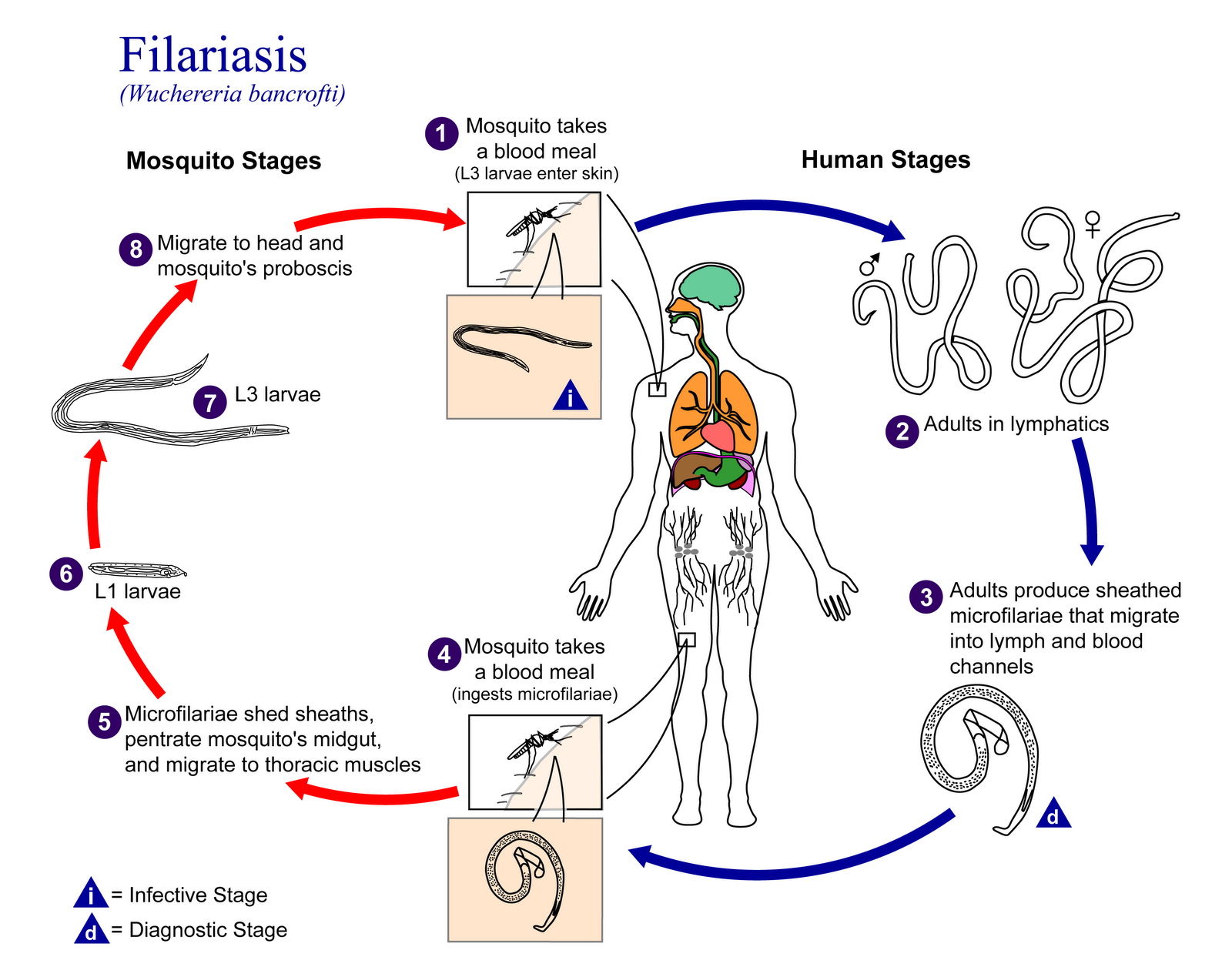


Unfortunately, there is currently no vaccine that is available for this disease. People who live in areas that are at risk of the disease would be given two drugs annually – albendazole with invermectin or with diethylcarbamazine citrate – to prevent the spread of the infection. Although the disease is rarely fatal, it is important to treat the disease early to prevent severe disability.


Works Cited

King, C.L. Transmission intensity and human immune responses to lymphatic filariasis. Parasite Immunology 2001; 23.
Wayangankar, S. [Internet] Filariasis; 2013 [Cited 2014 April 4]. Available from: http://emedicine.medscape.com/article/217776-overview#a0156
World Health Organization [Internet]. WHO; 2014 [Cited 2014 April 4]. Available from: http://www.who.int/mediacentre/factsheets/fs102/en/ 

Friday, March 28, 2014

Encounter #3

One of the requirements of one my classes called HLSC 101 – Intro to Health Care involves shadowing a health care professional of your choosing. After several obstacles, I was given the opportunity to shadow a physician assistant at Holy Cross Hospital. However, Dr. McKenzie told me, this past Monday, that I needed a recent documentation of my current flu shot as well as a tuberculosis (TB) test document. This would ensure the safety of the people that I would come into contact with and myself.

            Tuberculosis is an infectious disease that is caused by Mycobacterium tuberculosis. One of the main issues with this disease is that it can be easily transmitted from person to person through the air. This disease can be fatal and is currently affecting about one-third of the world’s population. (To learn more about tuberculosis read my blog entry for February 21, 2014 titled Investigations #1). I had a flu shot before but I have never had a TB test to my knowledge. I will receive a tuberculin skin test next week from my doctor. Basically I learned that the doctor would inject a fluid into my skin called tuberculin and after 2-3 days I will come back to have my arm checked for a reaction. If a person has a positive skin test, they would have a raised, hard area or swelling that is present in the skin. If they do not, then there would not be any hard area or swelling that is present in the skin.


Source: http://www.cdc.gov/tb/topic/testing/default.htm 

Friday, March 21, 2014

Dictionary #3

1. a) Exogenous pathway: Intracellular route taken by antigen that is processed for presentation by MHC class II, typically associate with proteins that are endocytosed.
b) Endogenous pathway: Intracellular route taken by antigen that is processed for presentation by MHC class I, typically associated with proteins generated in the cytosol.


2. Lipid Rafts: Parts of the membrane characterized by highly ordered, detergent-insoluble, sphingolipid- and cholesterol-rich regions. 


3. Periarteriolar lymphoid sheath (PALS): A collar of lymphocytes encasing small arterioles of the spleen. 


Friday, March 7, 2014

Reflections #2


We are closing in on the half way mark of the semester with spring break next week. I have to say that the first half of Immunology has been quite the learning experience. Immunology is my first of many 400 level classes in college and although this class requires a lot of work, everything that Dr. V assigns are relevant and serves a purpose. I have encountered many teachers who assign work just to show that they are doing something in their class, even though the work may not be helpful (busy work). However, this is not the case with Dr. V. 
Immunology has really changed the way I observe things around me. For example, if I see a person who is sick I start diagnosing what is wrong with their immune system. All of the labs for this class are well organized and it actually fits perfectly into what we were learning in class. This is a big deal for me because I have been in quite a few labs in years past that were not organized and/or fit into what we were learning in class. The material that I learn in both lecture and lab will surely help me as I advance to more higher-level science courses and eventually my career as a medical laboratory scientist and a physician assistant. I am excited for what the second half of Immunology has in store. 

Thursday, February 27, 2014

Investigations #2

The other day, while flipping through my parent’s medical books in the library at our house, I saw a picture of a man with an enlarged thyroid gland. I was shocked at how enlarged the man’s thyroid gland was, so I wanted to investigate more on the disease called Hashimoto’s disease. I discovered that Hashimoto’s disease is an autoimmune disease, where the immune system sends T cells and create antibodies that would destroy a person’s thyroid tissue/gland. Interestingly enough, doctors currently do not know what causes one’s immune system to attack their thyroid gland. However, some suspect it is due to a virus or bacterium that might have triggered the response, while there are others who believe it is due to genetic flaws. It is found that women are more likely to develop the disease than men.


Hashimoto’s disease slowly progresses as one ages. Thyroid hormones would begin to decrease, TSH levels would increase as a result of decreased negative feedback, and goiter is likely to develop. The signs and symptoms of Hashimoto’s disease are basically under the general category of hypothyroidism, which include fatigue, puffy face, hoarse voice, pain and stiffness in joints, swelling in various parts of the body, muscle aches, and unexplained weight gain (mostly fluid). The treatments for Hashimoto’s disease involves daily replacement with pharmaceutical preparations of T4, which restores the thyroid hormone levels and decrease TSH levels back to normal.


References

"Hashimoto's Disease." Symptoms. Mayo Clinic, 2 Jan. 2014. Web. 27 Feb. 2014.

Widmaier, Eric P., Hershel Raff, Kevin T. Strang, and Arthur J. Vander. Vander's Human Physiology: The Mechanisms of Body Function. New York: McGraw-Hill, 2011. Print.